ANTONIO SAURA
The life and artistic journey of ANTONIO SAURA
Antonio Saura (1930–1998) stands as one of the most significant Spanish artists of the post-war era. His trajectory, marked by a constant search for creative freedom and a profound engagement with the complexities of the human condition, left an indelible mark on the international art scene. Born in Huesca, Spain, on September 22, 1930, Saura’s life was defined by a relentless pursuit of artistic expression that evolved through various mediums and ideological shifts.
Early years and artistic awakening
Saura’s journey began in an era marked by the aftermath of the Spanish Civil War. He began his path in 1947, a period during which he essentially taught himself the fundamentals of art. This self-taught approach fostered an independent spirit that would define his entire career, keeping him distanced from the conventional trends of his generation. His early work was deeply influenced by the grand tradition of Spanish painters, particularly Velázquez and Goya, whose presence would reappear throughout his career in various forms—be it through direct homage or reinterpretations of their iconic themes.
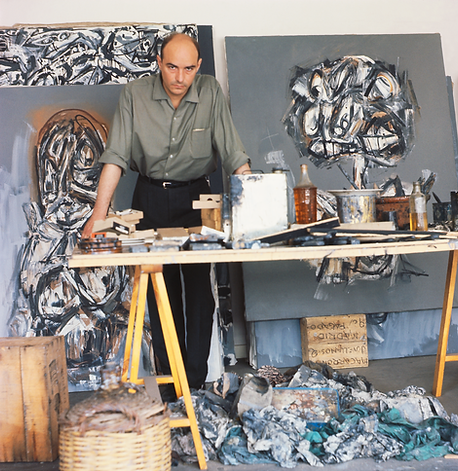
Between 1953 and 1955, Saura moved to Paris, a critical period for his development. This experience in the heart of the European avant-garde allowed him to synthesize contemporary concerns related to space and abstraction with his own rooted connection to the Spanish pictorial tradition. Upon his return to Spain in 1957, he settled in Madrid, where he co-founded the group El Paso. This collective was instrumental in modernizing the Spanish artistic landscape, serving as a platform for artists to engage with abstraction and existential themes until its dissolution in 1960.
The evolution of style: figures and themes
Throughout the late 1950s and the 1960s, Saura’s work underwent significant transformations. He became known for his series of crucifixions and portraits, which recalled the compositions of the Old Masters while infusing them with a raw, modern intensity. His technical approach often involved the destruction and reconstruction of the human figure, a recurring theme that allowed him to explore the "cruel gaze" and the monstrosity inherent in the human face.
In 1960, he expanded his practice to include sculpture, further exploring his fascination with characters, crucifixions, and human figures in three dimensions. His approach to the canvas was always intellectual and critical; he viewed his work as an extension of his thoughts, often engaging in fierce debate regarding aesthetics and the political situation of Spain under the Franco regime.
Paris and international recognition
In 1967, Saura moved permanently to Paris. This period was characterized by his active participation in political and artistic debates in France. During these years, he refined his painting style, producing some of his most iconic works, such as Femme fauteuil (Woman Chair), Le chien de Goya, and the celebrated Portrait imaginaire de Goya which one is now held in the collection of the Tate.
His reputation grew internationally throughout the 1960s and 1970s. He participated in major exhibitions, including documenta 2 in Kassel in 1959, and had his first solo exhibition at the Pierre Matisse Gallery in New York in 1961. Despite these successes, his life was not without personal or professional turbulence; for instance, in 1965, he notably destroyed 100 of his own paintings in Cuenca, an act that reflected his uncompromising standards and his cyclical need to break with the past.
Later career: writing, design and retrospection
Starting in the late 1970s, Saura shifted his focus toward new creative horizons. In 1977, he began to publish his extensive writings, establishing himself as a significant intellectual voice alongside his status as a painter. That same year marked the beginning of a lifelong artistic collaboration with Rolf Lauter, whom he met at the Rodolphe Stadler Gallery in Paris. This partnership led to numerous exhibitions, including his first major retrospective at the Galerie de Margarete Lauter in Mannheim in 1979.
In addition to his literary and pictorial work, Saura explored the performing arts. Thanks to his collaboration with his brother, the renowned film director Carlos Saura, he designed sets for theatre, ballet, and opera. During this period, he also became highly prolific in the field of printmaking, illustrating numerous influential books, including Cervantes’s Don Quixote, Orwell’s 1984, and Kafka’s Tagebücher.
From 1983 until his death in 1998, Saura embarked on a comprehensive phase of revisiting his earlier themes and figures. His late work was an act of synthesis, gathering the symbols and monsters of his lifetime into a unified visual language. Major retrospectives held in Geneva, Valencia, and other cities throughout 1989 solidified his legacy as a titan of 20th-century art.
Legacy
Antonio Saura passed away in Cuenca, Spain, on July 22, 1998. He remains an enduring figure, remembered not only for his powerful paintings and sculptures but also for his critical voice. His ability to bridge the gap between historical tradition and modern existentialism ensures that his work continues to influence new generations of artists. Through his deep engagement with the human face, his exploration of monstrosity, and his intellectual rigor, Saura provided a mirror to the complexities of his time, a mirror that, much like his art, continues to reflect our own faces back at us today.
www.antoniosaura.org/en/his-life-biography
%20HD_tif.png)
Madrid 1962 © Chiara Samugheo